12  Data Analysis


12.1 Why be reproducible?

First, revist https://jadamso.github.io/Rbooks/00_01_FirstSteps.html#why-program-in-r. Then consider the counterfactual below. Future economists should also read https://core.ac.uk/download/pdf/300464894.pdf.

An example workflow.

First Steps…

Step 1: Some ideas and data about how variable \(X_{1}\) affects variable \(Y_{1}\), which we denote as \(X_{1}\to Y_{1}\)

  • You copy some data into a spreadsheet, manually aggregate
  • do some calculations and tables the same spreadsheet
  • some other analysis from here and there, using this software and that.

Step 2: Pursuing the lead for a week or two

  • you extend your dataset with more observations
  • copy in a spreadsheet data, manually aggregate
  • do some more calculations and tables, same as before

A Little Way Down the Road …

1 month later: someone asks about another factor: \(X_{2} \to Y\).

  • you download some other type of data
  • You repeat Step 2 with some data on \(X_{2}\).
  • The details from your “point and click” method are a bit fuzzy.
  • It takes a little time, but you successfully redo the analysis.

4 months later: someone asks about yet another factor: \(X_{3}\to Y_{1}\).

  • You again repeat Step 2 with some data on \(X_{3}\).
  • You’re pretty sure none of tables your tried messed up the order of the rows or columns.
  • It takes more time and effort. The data processing was not transparent, but you eventually redo the analysis.

6 months later: you want to explore another outcome: \(X_{2} \to Y_{2}\).

2 years later: your boss wants you to replicate your work: \(X_{1}, X_{2}, X_{3} \to Y_{1}\).

  • A rival has proposed something new. Their idea doesn’t actually make any sense, but their figures and statistics look better.
  • You don’t even use that computer anymore and a collaborator who handled the data on \(X_{2}\) has moved on.

An alternative workflow.

Suppose you decided to code what you did beginning with Step 2.

It does not take much time to update or replicate your results.

  • Your computer runs for 2 hours and reproduces the figures and tables.
  • You also rewrote your big calculations to use multiple cores, this took two hours to do but saved 6 hours each time you rerun your code.
  • You add some more data. It adds almost no time to see whether much has changed.

Your results are transparent and easier to build on.

12.2 Additional Functionality

As part of a data analysis pipeline, we will often use expansion “packages” that allow for more functionality. We will discuss these first, before moving to the data analysis pipeline.

Packages.

Most packages can be easily installed from the internet via CRAN.

Code
# common packages for tables/figures
install.packages("plotly")
install.packages("reactable")
install.packages("stargazer")

# common packages for data/teaching
install.packages("AER")
install.packages("Ecdat")
install.packages('wooldridge')

# other packages for statistics and data handling
install.packages("extraDistr")
install.packages("twosamples")
install.packages("data.table")

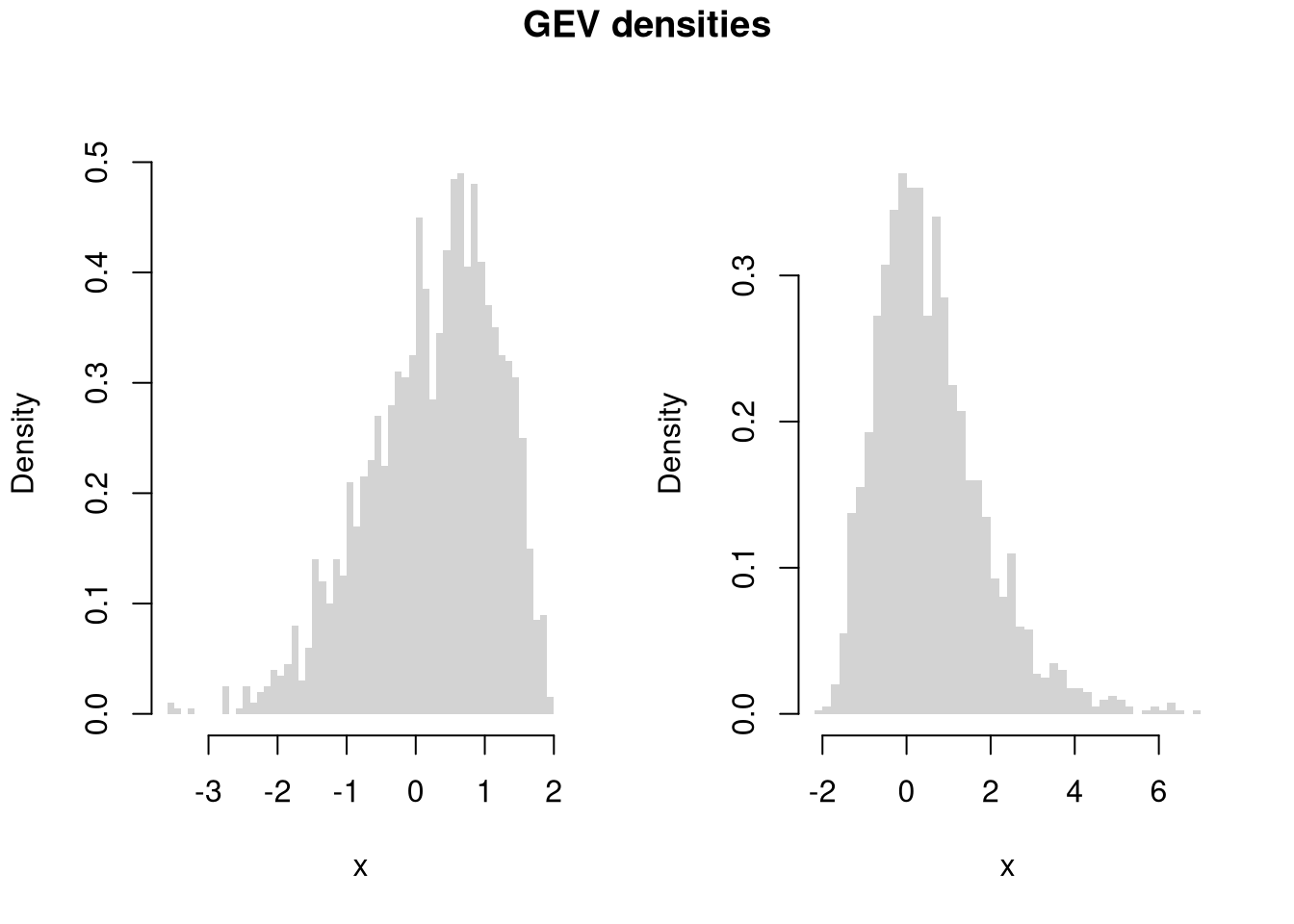
You only need to install packages once. But you need to load the package via library every time you want the extended functionality. For example, to generate exotic probability distributions

Code
# install.packages("extraDistr"), once ever
library(extraDistr) # every time you need it

par(mfrow=c(1,2))
for(p in c(-.5,0)){
    x <- rgev(2000, mu=0, sigma=1, xi=p)
    hist(x, breaks=50, border=NA, main=NA, freq=F)
}
title('GEV densities', outer=T, line=-1)

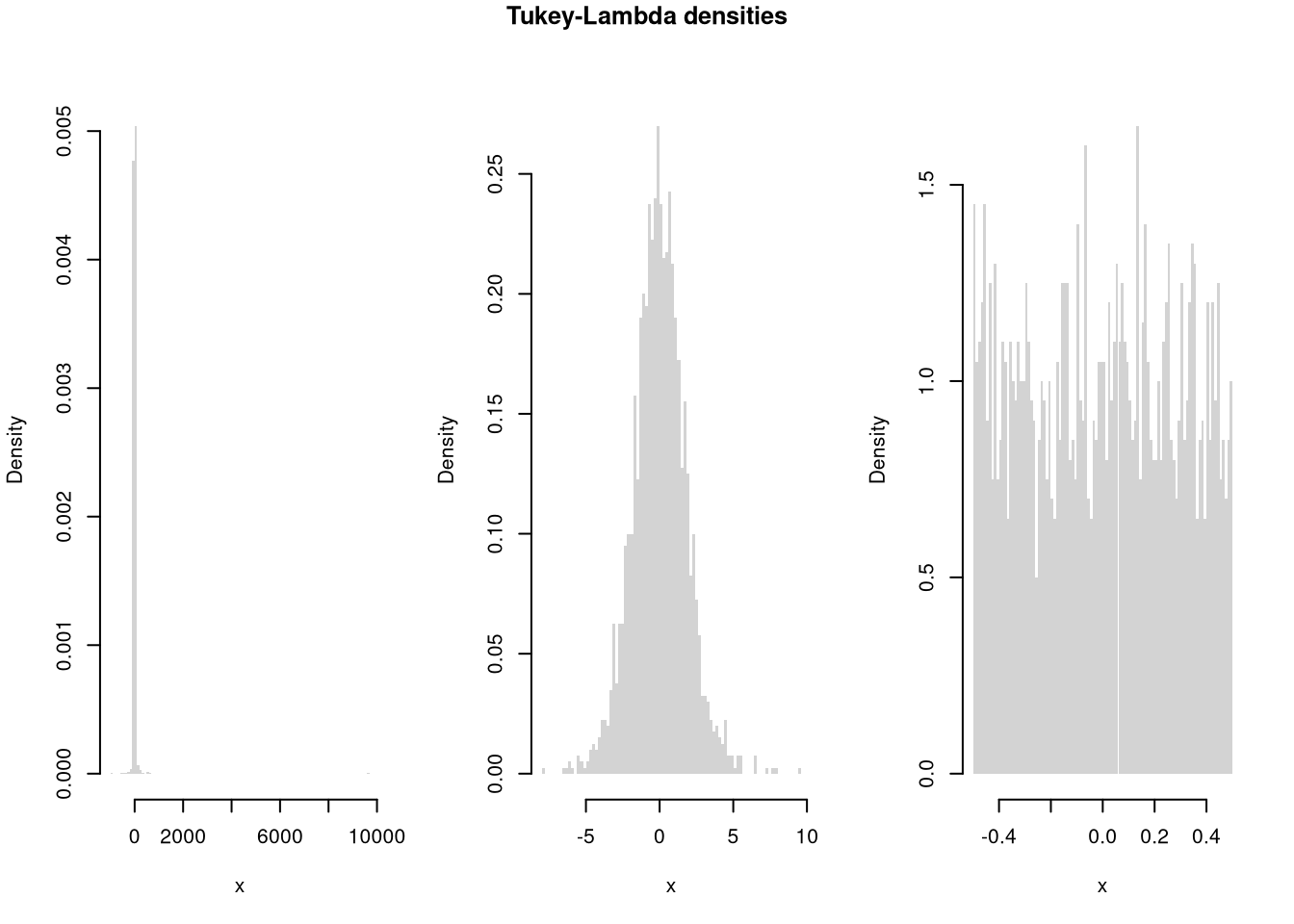
Code
library(extraDistr)

par(mfrow=c(1,3))
for(p in c(-1, 0,2)){
    x <- rtlambda(2000, p)
    hist(x, breaks=100, border=NA, main=NA, freq=F)
}
title('Tukey-Lambda densities', outer=T, line=-1)

The most common packages also have cheatsheets you can use.

We can also load other datasets using “packages”. For example, the “wooldridge” package contains datasets on crime. To use this data, we must first install the package on our computer. Then, to access the data, we must first load the package.

Code
# Install R Data Package and Load in
install.packages('wooldridge') # only once
library('wooldridge') # anytime you want to use the data

data('crime2') 
data('crime4')

Base.

While additional packages can make your code faster, they also create dependencies that can lead to problems. So learn base R well before becoming dependent on other packages

Github Packages.

Advanced and Optional

Sometimes you will want to install a package from GitHub. For this, you can use devtools or its light-weight version remotes

To color terminal output on Linux systems, for example, you can use the colorout package

Code
# install.packages("remotes")
library(remotes)
# Install <https://github.com/jalvesaq/colorout
# to .libPaths()[1]
install_github('jalvesaq/colorout')
library(colorout)

To use devtools instead, you also need to have software developer tools installed on your computer.

Updating.

Make sure R and your packages are up to date. The current version of R and any packages used can be found (and recorded) with

Code
sessionInfo()

To update your R packages, use

Code
update.packages()

After updating R, you can update all packages stored on your computer (in all .libPaths())

Code
update.packages(checkBuilt=T, ask=F)
# install.packages(old.packages(checkBuilt=T)[,"Package"])

12.3 Inputs

Reading Data.

The first step in data analysis is getting data into R. There are many ways to do this, depending on your data structure. Perhaps the most common case is reading in a csv file.

Code
# Read in csv (downloaded from online)
# download source 'http://www.stern.nyu.edu/~wgreene/Text/Edition7/TableF19-3.csv'
# download destination '~/TableF19-3.csv'
read.csv('~/TableF19-3.csv')
 
# Can read in csv (directly from online)
# dat_csv <- read.csv('http://www.stern.nyu.edu/~wgreene/Text/Edition7/TableF19-3.csv')

We can use packages to access many different types of data. To read in a Stata data file, for example, we can use the “haven” package.

Code
# Read in stata data file from online
#library(haven)
#dat_stata <- read_dta('https://www.ssc.wisc.edu/~bhansen/econometrics/DS2004.dta')
#dat_stata <- as.data.frame(dat_stata)

# For More Introductory Econometrics Data, see 
# https://www.ssc.wisc.edu/~bhansen/econometrics/Econometrics%20Data.zip
# https://pages.stern.nyu.edu/~wgreene/Text/Edition7/tablelist8new.htm
# R packages: wooldridge, causaldata, Ecdat, AER, ....

Cleaning Data.

Data transformation is often necessary before analysis, so remember to be careful and check your code is doing what you want. (If you have large datasets, you can always test out the code on a sample.)

Code
# Function to Create Sample Datasets
make_noisy_data <- function(n, b=0){
    # Simple Data Generating Process
    x <- seq(1,10, length.out=n) 
    e <- rnorm(n, mean=0, sd=10)
    y <- b*x + e 
    # Obervations
    xy_mat <- data.frame(ID=seq(x), x=x, y=y)
    return(xy_mat)
}

# Two simulated datasets
dat1 <- make_noisy_data(6)
dat2 <- make_noisy_data(6)

# Merging data in long format
dat_merged_long <- rbind(
    cbind(dat1,DF=1),
    cbind(dat2,DF=2))

Now suppose we want to transform into wide format

Code
# Merging data in wide format, First Attempt
dat_merged_wide <- cbind( dat1, dat2)
names(dat_merged_wide) <- c(paste0(names(dat1),'.1'), paste0(names(dat2),'.2'))

# Merging data in wide format, Second Attempt
# higher performance
dat_merged_wide2 <- merge(dat1, dat2,
    by='ID', suffixes=c('.1','.2'))
## CHECK they are the same.
identical(dat_merged_wide, dat_merged_wide2)
## [1] FALSE
# Inspect any differences

# Merging data in wide format, Third Attempt with dedicated package
# (highest performance but with new type of object)
library(data.table)
dat_merged_longDT <- as.data.table(dat_merged_long)
dat_melted <- melt(dat_merged_longDT, id.vars=c('ID', 'DF'))
dat_merged_wide3 <- dcast(dat_melted, ID~DF+variable)

## CHECK they are the same.
identical(dat_merged_wide, dat_merged_wide3)
## [1] FALSE

Often, however, we ultimately want data in long format

Code
# Merging data in long format, Second Attempt with dedicated package 
dat_melted2 <- melt(dat_merged_wide3, measure=c("1_x","1_y","2_x","2_y"))
melt_vars <- strsplit(as.character(dat_melted2[['variable']]),'_')
dat_melted2[,'DF'] <- sapply(melt_vars, `[[`,1)
dat_melted2[,'variable'] <- sapply(melt_vars, `[[`,2)
dat_merged_long2 <- dcast(dat_melted2, DF+ID~variable)
dat_merged_long2 <- as.data.frame(dat_merged_long2)

## CHECK they are the same.
identical( dat_merged_long2, dat_merged_long)
## [1] FALSE

# Further Inspect
dat_merged_long2 <- dat_merged_long2[,c('ID','x','y','DF')]
mapply( identical, dat_merged_long2, dat_merged_long)
##    ID     x     y    DF 
##  TRUE  TRUE  TRUE FALSE

Inspecting Data.

You can find a value by a particular criterion

Code
y <- 1:10

# Return Y-value with minimum absolute difference from 3
abs_diff_y <- abs( y - 3 ) 
abs_diff_y # is this the luckiest number?
##  [1] 2 1 0 1 2 3 4 5 6 7

min(abs_diff_y)
## [1] 0
which.min(abs_diff_y)
## [1] 3
y[ which.min(abs_diff_y) ]
## [1] 3

There are also some useful built in functions for standardizing data

Code
m <- matrix(c(1:3,2*(1:3)),byrow=TRUE,ncol=3)
m
##      [,1] [,2] [,3]
## [1,]    1    2    3
## [2,]    2    4    6

# normalize rows
m/rowSums(m)
##           [,1]      [,2] [,3]
## [1,] 0.1666667 0.3333333  0.5
## [2,] 0.1666667 0.3333333  0.5

# normalize columns
t(t(m)/colSums(m))
##           [,1]      [,2]      [,3]
## [1,] 0.3333333 0.3333333 0.3333333
## [2,] 0.6666667 0.6666667 0.6666667

# de-mean rows
sweep(m,1,rowMeans(m), '-')
##      [,1] [,2] [,3]
## [1,]   -1    0    1
## [2,]   -2    0    2

# de-mean columns
sweep(m,2,colMeans(m), '-')
##      [,1] [,2] [,3]
## [1,] -0.5   -1 -1.5
## [2,]  0.5    1  1.5

You can also easily bin and aggregate data

Code
x <- 1:10
cut(x, 4)
##  [1] (0.991,3.25] (0.991,3.25] (0.991,3.25] (3.25,5.5]   (3.25,5.5]  
##  [6] (5.5,7.75]   (5.5,7.75]   (7.75,10]    (7.75,10]    (7.75,10]   
## Levels: (0.991,3.25] (3.25,5.5] (5.5,7.75] (7.75,10]
split(x, cut(x, 4))
## $`(0.991,3.25]`
## [1] 1 2 3
## 
## $`(3.25,5.5]`
## [1] 4 5
## 
## $`(5.5,7.75]`
## [1] 6 7
## 
## $`(7.75,10]`
## [1]  8  9 10
Code
xs <- split(x, cut(x, 4))
sapply(xs, mean)
## (0.991,3.25]   (3.25,5.5]   (5.5,7.75]    (7.75,10] 
##          2.0          4.5          6.5          9.0

# shortcut
aggregate(x, list(cut(x,4)), mean)
##        Group.1   x
## 1 (0.991,3.25] 2.0
## 2   (3.25,5.5] 4.5
## 3   (5.5,7.75] 6.5
## 4    (7.75,10] 9.0

See also https://bookdown.org/rwnahhas/IntroToR/logical.html

12.4 Outputs

Interactive Figures.

Notably, histograms, boxplots, and scatterplots

Code
library(plotly) #install.packages("plotly")
USArrests[,'ID'] <- rownames(USArrests)

# Scatter Plot
fig <- plot_ly(
    USArrests, x = ~UrbanPop, y = ~Assault,
    mode='markers',
    type='scatter',
    hoverinfo='text',
    marker=list( color='rgba(0, 0, 0, 0.5)'),
    text = ~paste('<b>', ID, '</b>',
        "<br>Urban  :", UrbanPop,
        "<br>Assault:", Assault))
fig <- layout(fig,
    showlegend=F,
    title='Crime and Urbanization in America 1975',
    xaxis = list(title = 'Percent of People in an Urban Area'),
    yaxis = list(title = 'Assault Arrests per 100,000 People'))
fig
Code
# Box Plot
fig <- plot_ly(USArrests,
    y=~Murder, color=~cut(UrbanPop,4),
    alpha=0.6, type="box",
    pointpos=0, boxpoints = 'all',
    hoverinfo='text',    
    text = ~paste('<b>', ID, '</b>',
        "<br>Urban  :", UrbanPop,
        "<br>Assault:", Assault,
        "<br>Murder :", Murder))    
fig <- layout(fig,
    showlegend=FALSE,
    title='Crime and Urbanization in America 1975',
    xaxis = list(title = 'Percent of People in an Urban Area'),
    yaxis = list(title = 'Murders Arrests per 100,000 People'))
fig
Code
pop_mean <- mean(USArrests[,'UrbanPop'])
pop_cut <- USArrests[,'UrbanPop'] < pop_mean
murder_lowpop <- USArrests[ pop_cut,'Murder']
murder_highpop <- USArrests[ !pop_cut,'Murder']

# Overlapping Histograms
fig <- plot_ly(alpha=0.6, hovertemplate="%{y}")
fig <- add_histogram(fig, murder_lowpop, name='Low Pop. (< Mean)',
    histnorm = "probability density",
    xbins = list(start=0, size=2))
fig <- add_histogram(fig, murder_highpop, name='High Pop (>= Mean)',
    histnorm = "probability density",
    xbins = list(start=0, size=2))
fig <- layout(fig,
    barmode="overlay",
    title="Crime and Urbanization in America 1975",
    xaxis = list(title='Murders Arrests per 100,000 People'),
    yaxis = list(title='Density'),
    legend=list(title=list(text='<b> % Urban Pop. </b>')) )
fig
Code

# Possible, but less preferable, to stack histograms
# barmode="stack", histnorm="count"

Note that many plots can be made interactive via https://plotly.com/r/. For more details, see examples and then applications.

If you have many points, for example, you can make a 2D histogram.

Code
library(plotly)
fig <- plot_ly(
    USArrests, x = ~UrbanPop, y = ~Assault)
fig <- add_histogram2d(fig, nbinsx=25, nbinsy=25)
fig

Interactive Tables.

You can create an interactive table to explore raw data.

Code
data("USArrests")
library(reactable)
reactable(USArrests, filterable=T, highlight=T)

You can create an interactive table that summarizes the data too.

Code
# Compute summary statistics
vars <- names(USArrests)
stats_list <- lapply(vars, function(v) {
  x <- USArrests[[v]]
  c(
    Variable = v,
    N       = sum(!is.na(x)),
    Mean    = mean(x, na.rm = TRUE),
    SD      = sd(x, na.rm = TRUE),
    Min     = min(x, na.rm = TRUE),
    Q1      = as.numeric(quantile(x, 0.25, na.rm = TRUE)),
    Median  = median(x, na.rm = TRUE),
    Q3      = as.numeric(quantile(x, 0.75, na.rm = TRUE)),
    Max     = max(x, na.rm = TRUE)
  )
})

# Convert list to data frame with numeric columns 
stats_df <- as.data.frame(do.call(rbind, stats_list), stringsAsFactors = FALSE)
num_cols <- setdiff(names(stats_df), "Variable")
stats_df[num_cols] <- lapply(stats_df[num_cols], function(i){
    round(as.numeric(i), 3)
})

# Display interactively
reactable(stats_df)

Polishing.

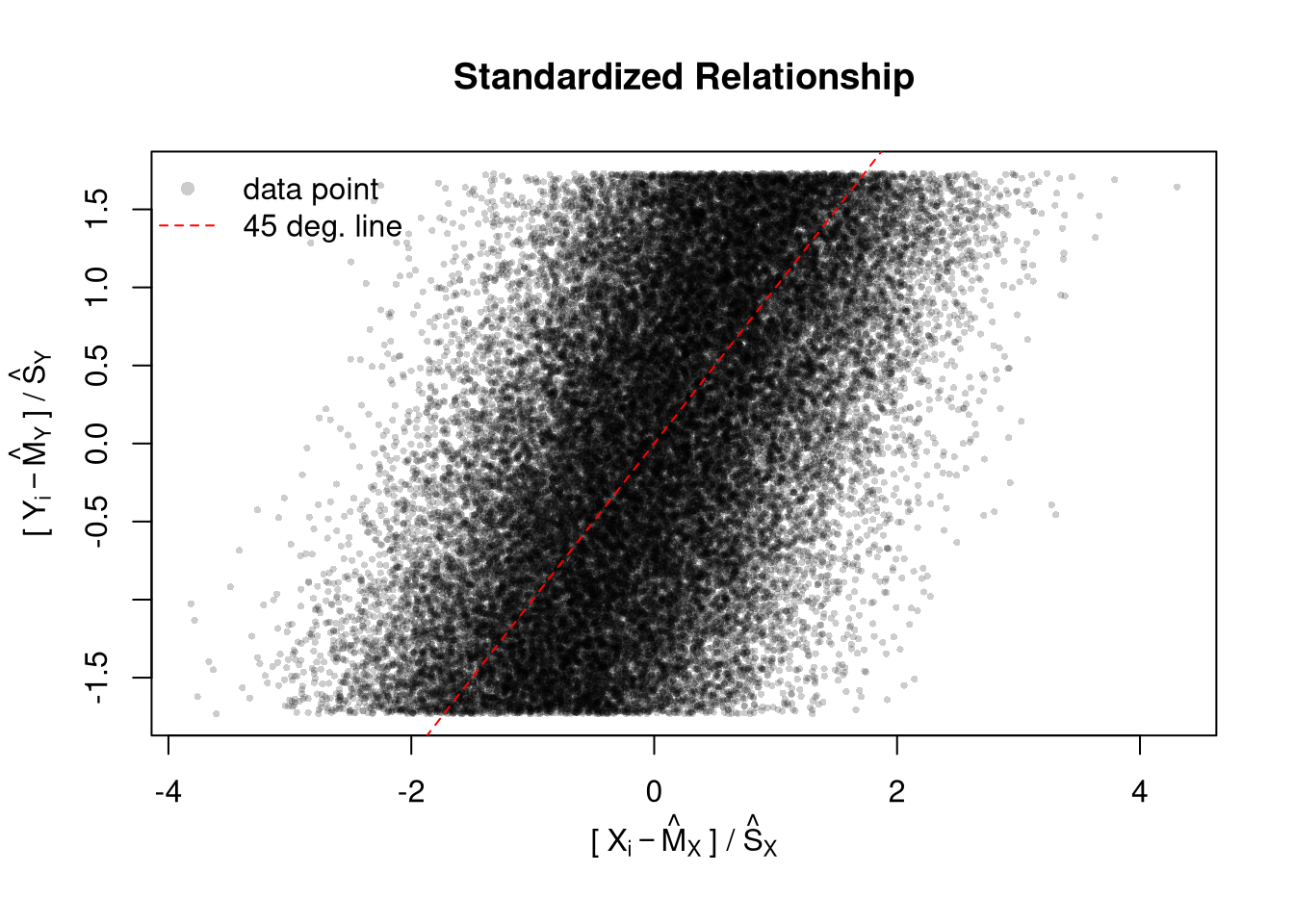
Your first figures are typically standard, and probably not as good as they should be. Edit your plot to focus on the most useful information. For others to easily comprehend your work, you must also polish the plot. When polishing, you must do two things:

  • Add details that are necessary.
  • Remove details that are not necessary.
Code
# Random Data
x <- seq(1, 10, by=.0002)
e <- rnorm(length(x), mean=0, sd=1)
y <- .25*x + e 

# First Draft
# plot(x, y)

# Second Draft: Focus
# (In this example: relationship magnitude)
xs <- scale(x)
ys <- scale(y)
plot(ys, xs, 
    xlab='', ylab='',
    pch=16, cex=.5, col=grey(0,.2))
mtext(expression('['~X[i]-hat(M)[X]~'] /'~hat(S)[X]), 1, line=2.5)
mtext(expression('['~Y[i]-hat(M)[Y]~'] /'~hat(S)[Y]), 2, line=2.5)
# Add a 45 degree line
abline(a=0, b=1, lty=2, col='red')
legend('topleft', 
    legend=c('data point', '45 deg. line'),
    pch=c(16,NA), lty=c(NA,2), col=c(grey(0,.2), 'red'), 
    bty='n')
title('Standardized Relationship')

Code
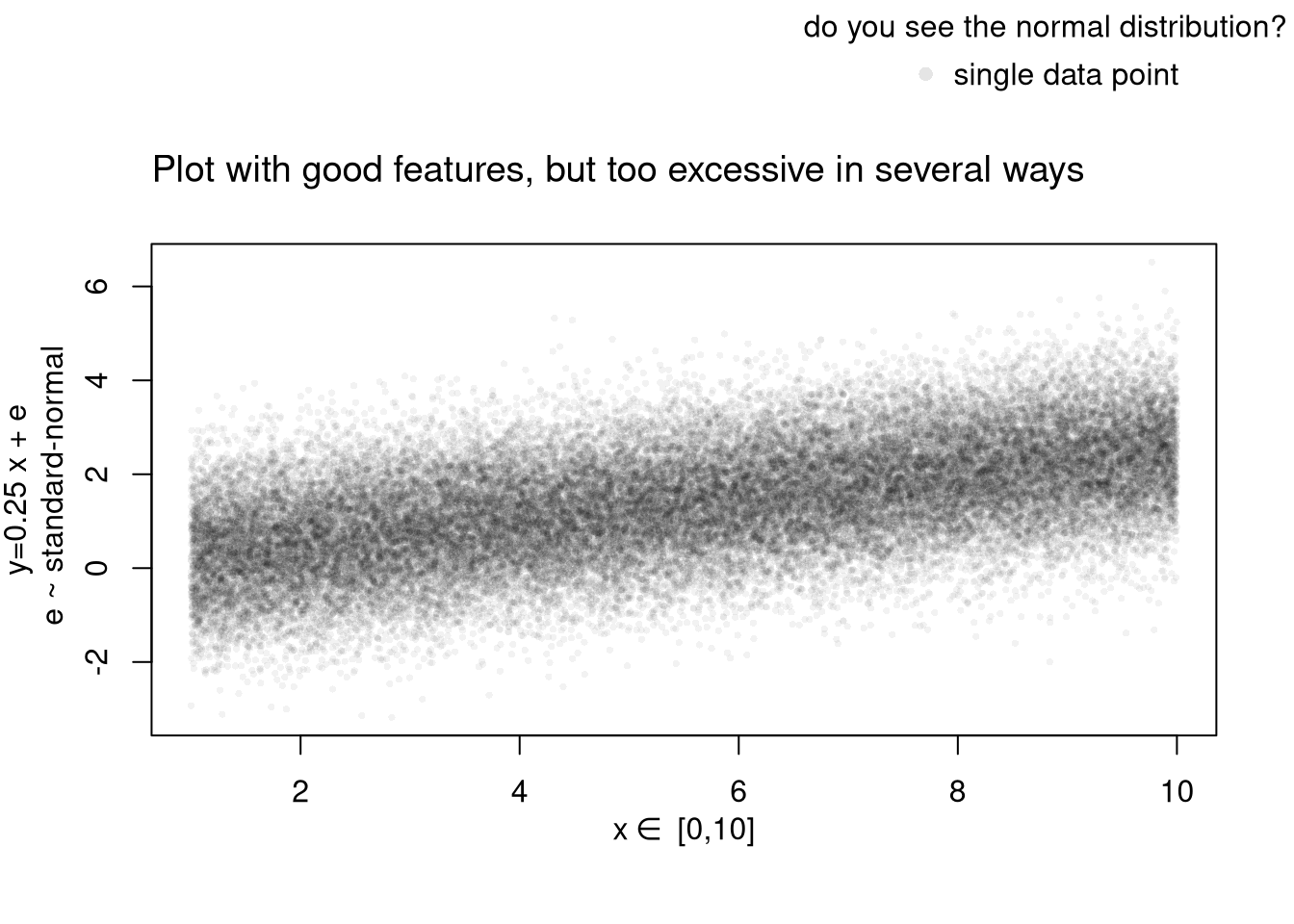
# Another Example
xy_dat <- data.frame(x=x, y=y)
par(fig=c(0,1,0,0.9), new=F)
plot(y~x, xy_dat, pch=16, col=rgb(0,0,0,.05), cex=.5,
    xlab='', ylab='') # Format Axis Labels Seperately
mtext( 'y=0.25 x + e\n e ~ standard-normal', 2, line=2.2)
mtext( expression(x%in%~'[0,10]'), 1, line=2.2)
#abline( lm(y~x, data=xy_dat), lty=2)
title('Plot with good features, but too excessive in several ways',
    adj=0, font.main=1)

# Outer Legend (https://stackoverflow.com/questions/3932038/)
outer_legend <- function(...) {
  opar <- par(fig=c(0, 1, 0, 1), oma=c(0, 0, 0, 0), 
    mar=c(0, 0, 0, 0), new=TRUE)
  on.exit(par(opar))
  plot(0, 0, type='n', bty='n', xaxt='n', yaxt='n')
  legend(...)
}
outer_legend('topright', legend='single data point',
    title='do you see the normal distribution?',
    pch=16, col=rgb(0,0,0,.1), cex=1, bty='n')
Learn to edit your figures:

Which features are most informative depends on what you want to show, and you can always mix and match. Ne aware that each type has benefits and costs. E.g., see

For small datasets, you can plot individual data points with a strip chart. For datasets with spatial information, a map is also helpful. Sometime tables are better than graphs (see https://www.edwardtufte.com/notebook/boxplots-data-test). For useful tips, see C. Wilke (2019) “Fundamentals of Data Visualization: A Primer on Making Informative and Compelling Figures” https://clauswilke.com/dataviz/

For plotting math, which should be done very sparingly, see https://astrostatistics.psu.edu/su07/R/html/grDevices/html/plotmath.html and https://library.virginia.edu/data/articles/mathematical-annotation-in-r

Static Publishing.

Advanced and Optional

You can export figures with specific dimensions

Code
pdf( 'Figures/plot_example.pdf', height=5, width=5)
# plot goes here
dev.off()

For exporting options, see ?pdf. For saving other types of files, see png("*.png"), tiff("*.tiff"), and jpeg("*.jpg")

You can also export tables in a variety of formats, including many that other software programs can easily read

Code
library(stargazer)
# summary statistics
stargazer(USArrests,
    type='html', 
    summary=T,
    title='Summary Statistics for USArrests')
Summary Statistics for USArrests
Statistic N Mean St. Dev. Min Max
Murder 50 7.788 4.356 0.800 17.400
Assault 50 170.760 83.338 45 337
UrbanPop 50 65.540 14.475 32 91
Rape 50 21.232 9.366 7.300 46.000

Note that many of the best plots are custom made (see https://www.r-graph-gallery.com/). Here are some ones that I have made over the years.

12.5 R-Markdown Reports

We will use R Markdown for communicating results to each other. Note that R and R Markdown are both languages. R studio interprets R code make statistical computations and interprets R Markdown code to produce pretty documents that contain both writing and statistics. Altogether, your project will use

  • R: does statistical computations
  • R Markdown: formats statistical computations for sharing
  • Rstudio: graphical user interface that allows you to easily use both R and R Markdown.

Homework reports are probably the smallest document you can create. They are simple reproducible reports made via R Markdown, which are almost entirely self-contained (showing both code and output). To make them, you need two additional packages

Code
# Packages for Rmarkdown
install.packages("knitr")
install.packages("rmarkdown")

# Other packages frequently used
#install.packages("plotly") #for interactive plots
#install.packages("sf") #for spatial data

You may need to first install additional software on your computer

Example 1: Simple Report.

Download the source file ReportTemplate_1Descriptive.Rmd and then then create it by following these steps

  • Open with Rstudio
  • Change the name to your own
  • Then either point-and-click “knit” or use the console to run rmarkdown::render('ReportTemplate_1Descriptive.Rmd')
  • Open the new .html file in your web browser (e.g., firefox).

12.6 Further Reading

For more on data cleaning, see

For more guidance on how to create Rmarkdown documents, see

If you are still lost, try one of the many online tutorials (such as these)