Code
# Attach the four-level region factor to USArrests; the levels
# are the values the categorical variable can take.
dat <- USArrests
dat$Region <- state.region
levels(dat$Region)
## [1] "Northeast" "South" "North Central" "West"So far we have used regression with cardinal explanatory variables. We now turn to factor variables that label which group each observation belongs to: regions, industries, treatment arms. The chapter builds up from the ANOVA decomposition of variation between and within groups, to its nonparametric Kruskal-Wallis analog, and finally back to a regression view in which group indicators are just another set of explanatory variables.
So far we have used cardinal explanatory variables where \(4-3=2-1\); many useful predictors are instead labels of group membership that do not arithmetic this way.
Factor variables are useful when group identity itself predicts the outcome (region, industry, treatment arm) and we want to compare group means within a regression framework. They split into two flavors:
One common case is if you have observations of individuals over time periods, then you may have two factor variables. An unordered factor that indicates who an individual is; for example \(\hat{D}_{i}=\mathbf{1}( \text{Individual} = i)\), and an ordered factor that indicates the time period; for example \(\hat{D}_{t}=\mathbf{1}( \text{Time} \in [\text{month}~ t, \text{month}~ t+1) )\). There are many other cases you see factor variables, including spatial ID’s in purely cross sectional data.
Be careful not to handle categorical data as if they were cardinal. E.g., generate city data with Leipzig=1, Lausanne=2, LosAngeles=3, … and then include city as if it were a cardinal number (that’s a big no-no). The same applied to ordinal data; PopulationLeipzig=2, PopulationLausanne=3, PopulationLosAngeles=1.
In this chapter, we use state.region (Northeast, South, North Central, West) as an unordered factor to group the USArrests data by US Census region.
# Attach the four-level region factor to USArrests; the levels
# are the values the categorical variable can take.
dat <- USArrests
dat$Region <- state.region
levels(dat$Region)
## [1] "Northeast" "South" "North Central" "West"With multiple groups, begin with a summary figure (such as a boxplot) and then run a global test of whether at least one group differs.
# Step 1: Visual summary
boxplot(Murder ~ Region, data = dat,
    col = hcl.colors(4, alpha = .45),
    ylab = 'Murder arrests (per 100k)', xlab = 'Region', main = NA)
title('Murder rates by region', font.main = 1)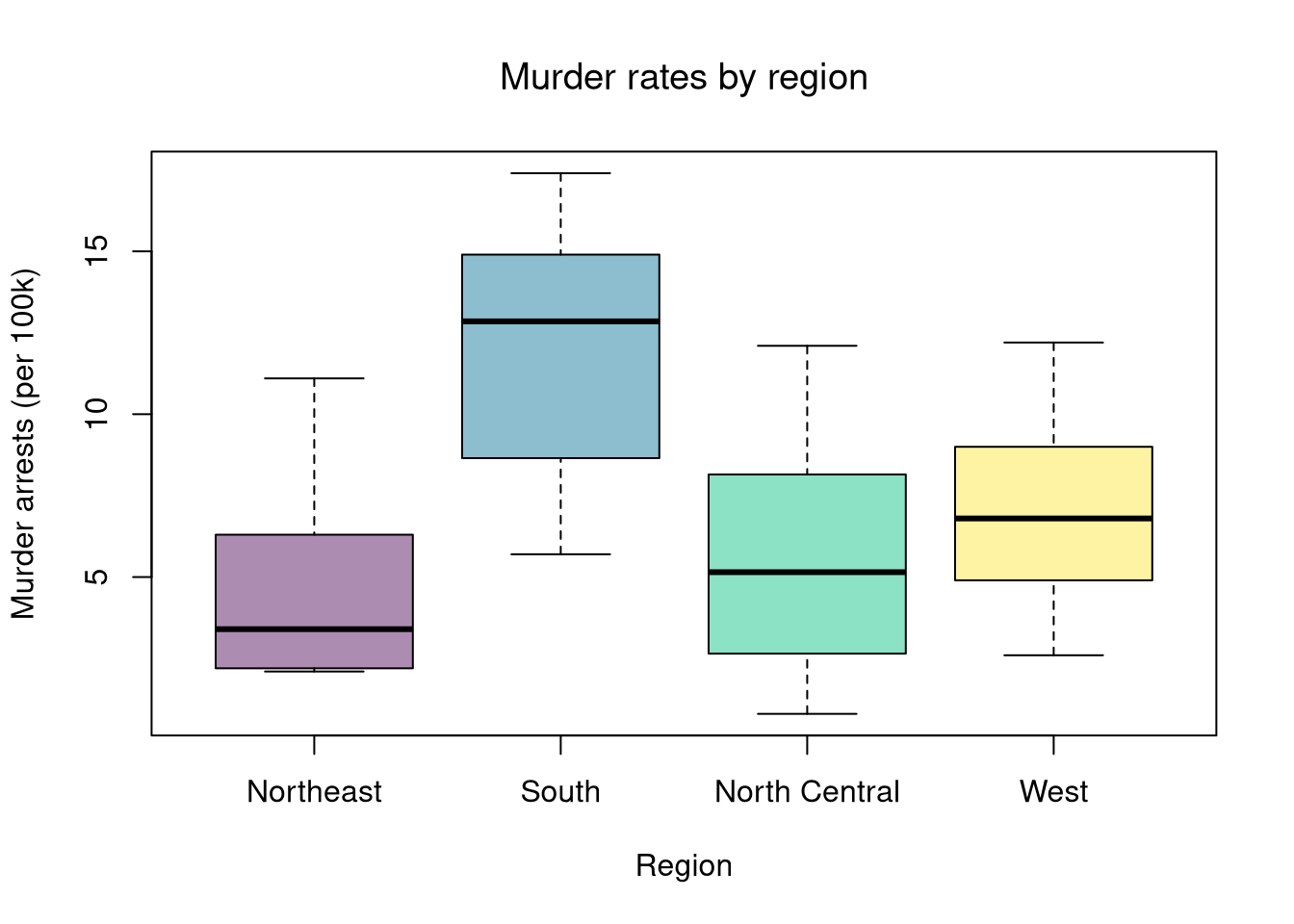
In Comparing Groups, we tested whether two groups had the same mean. We now extend this to \(G\) groups. The Analysis of Variance (ANOVA) approach asks: are the observed differences in group means larger than we would expect from random variation alone?
If group means differ, some of the spread in \(Y\) must come from differences between groups rather than within them. We can split each piece out.
The decomposition is useful as the foundation for any test of “do group means differ?”: if they do not, \(\hat{BSS}\) should be small relative to \(\hat{WSS}\). The equality holds exactly because the cross-term \(\sum_{g,i}(\hat{Y}_{ig}-\hat{M}_{g})(\hat{M}_{g}-\hat{M}_{Y})\) vanishes, since the within-group deviations sum to zero around their own group mean.
In R, aov() fits the ANOVA model and summary() returns the standard ANOVA table. The ANOVA table reports \(\hat{BSS}\) (“Sum Sq” for Region), \(\hat{WSS}\) (“Sum Sq” for Residuals).
# Fit ANOVA
fit_aov <- aov(Murder ~ Region, data = dat)
fit_aov
## Call:
##    aov(formula = Murder ~ Region, data = dat)
##
## Terms:
##                   Region Residuals
## Sum of Squares  391.2357  538.3171
## Deg. of Freedom        3        46
##
## Residual standard error: 3.420898
## Estimated effects may be unbalancedWe have the decomposition; now we need a single number that tells us when the between-group piece is “large” relative to the within-group piece.
The ANOVA F-statistic is useful as the global “do any means differ?” test: one number and one \(p\)-value, regardless of how many groups you have. The numerator is the average between-group variation per degree of freedom, the denominator is the average within-group variation, and a large \(\hat{F}\) means group means are more spread out than individual-level noise would predict.
F_fun <- function(Y,g){
    M_Y <- mean(Y)
    M_g <- aggregate(Y, list(g), mean)$x
    n_g <- aggregate(Y, list(g), length)$x

    BSS <- sum(n_g * (M_g - M_Y)^2)
    WSS <- sum(aggregate(Y, list(g), function(y) sum((y - mean(y))^2))$x)

    n <- length(Y)
    G <- nlevels(g)
    F_obs <- (BSS/(G-1)) / (WSS/(n-G))
}
F_obs <- F_fun(Y=dat$Murder, g=dat$Region)
F_obs
## [1] 11.14389
To compute a \(p\)-value, we can use permutation or bootstrap methods to build a null distribution, just as in previous chapters.
Pairing the observed Murder values with a resampled Region vector breaks the link between outcome and group: under the null, group labels are exchangeable, so this approximates the distribution of \(\hat{F}\) when no group effect exists.
# Pairs bootstrap: resample group labels to break the Y--group pairing
n <- nrow(dat)

F_nullboot <- vector(length=999)
for( b in seq_along(F_nullboot)){
    idx <- sample(n, replace = TRUE)
    g_boot <- dat[idx, 'Region']
    F_b <- F_fun(Y=dat$Murder, g=g_boot)
    F_nullboot[b] <- F_b
}

# Bootstrap p-value
p_boot <- mean(F_nullboot >= F_obs)
p_boot
## [1] 0

hist(F_nullboot, breaks = 40,
    col = grey(0.5, 0.5), border = NA,
    freq = FALSE, main = NA, xlab = 'Null Bootstrap F-statistic',
    xlim = c(0,14))
title('Null Bootstrap F-test', font.main = 1)
abline(v = F_obs, col = rgb(1, 0, 0, .8), lwd = 2)
legend('topright', legend = 'Observed F',
    col = rgb(1, 0, 0, .8), lwd =0, bty='n')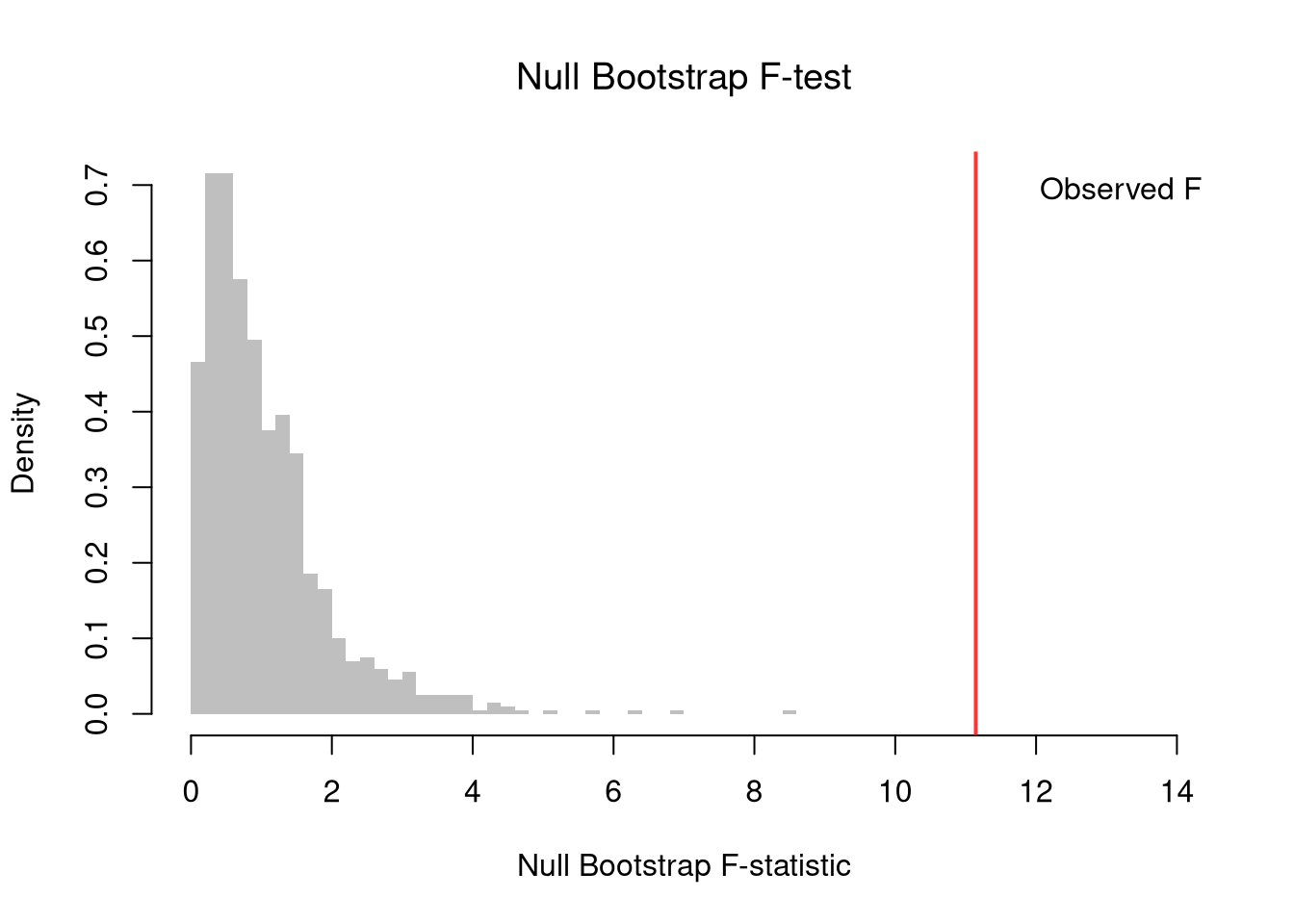
Under additional parametric assumptions (independent observations, equal variances, normal errors), \(\hat{F}\) (under the null) follows an \(F_{G-1,\;n-G}\) distribution. From that theoretical null distribution, we can then compute p-values (which is the default report method in R).
summary(fit_aov)
##             Df Sum Sq Mean Sq F value   Pr(>F)
## Region       3  391.2   130.4   11.14 1.28e-05 ***
## Residuals   46  538.3    11.7
## ---
## Signif. codes:  0 '***' 0.001 '**' 0.01 '*' 0.05 '.' 0.1 ' ' 1

p_param <- 1 - pf(F_obs, G-1, n-G)

 # Compare parametric and bootstrap p-values
cbind(F_obs, p_param, p_boot)
##         F_obs      p_param p_boot
## [1,] 11.14389 0.0001093623 0ANOVA tests whether group means differ; sometimes the entire distributions differ in ways the mean would miss.
When data are skewed, heavy-tailed, or only ordinal, a test built on means may overlook differences that show up in the rank order.
The Kruskal-Wallis test is useful when the equal-variance normal-error assumption is implausible, as with income, response times, or other heavy-tailed outcomes. Rank-based tests need only the orderings of the data. A significant result tells us that some distribution differs, but not which one; the global rejection has to be followed up with pairwise tests.
To conduct the test, first denote individuals \(i=1,...n\) with overall ranks \(\hat{r}_1,....\hat{r}_{n}\). Each individual belongs to group \(g=1,...G\), and each group \(g\) has \(n_{g}\) individuals with average rank \(\bar{r}_{g} = \sum_{i} \hat{r}_{i} /n_{g}\). The Kruskal Wallis statistic is \[\begin{eqnarray} \hat{KW} &=& (n-1) \frac{\sum_{g=1}^{G} n_{g}( \bar{r}_{g} - \bar{r} )^2 }{\sum_{i=1}^{n} ( \hat{r}_{i} - \bar{r} )^2}, \end{eqnarray}\] where \(\bar{r} = \frac{n+1}{2}\) is the grand mean rank.
In the special case with only two groups, the Kruskal Wallis test reduces to the Mann–Whitney U test (also known as the Wilcoxon rank-sum test). In this case, we can write the hypotheses in terms of individual outcomes in each group, \(Y_i\) in one group \(Y_j\) in the other; \(H_0: Prob(Y_i > Y_j)=Prob(Y_j > Y_i)\) versus \(H_A: Prob(Y_i > Y_j) \neq Prob(Y_j > Y_i)\). The corresponding test statistic is \[\begin{eqnarray} \hat{U} &=& \min(\hat{U}_1, \hat{U}_2) \\ \hat{U}_g &=& \sum_{i\in g}\sum_{j\in -g} \Bigl[\mathbf 1( \hat{Y}_{i} > \hat{Y}_{j}) + \tfrac12\mathbf 1(\hat{Y}_{i} = \hat{Y}_{j})\Bigr]. \end{eqnarray}\]
Interpretation template:
kw <- kruskal.test(Murder ~ Region, data = dat)
kw
##
##  Kruskal-Wallis rank sum test
##
## data:  Murder by Region
## Kruskal-Wallis chi-squared = 19.345, df = 3, p-value = 0.000232
A significant Kruskal-Wallis result tells us that some group differs, not which. To answer which, use a post-hoc pairwise test together with a multiple-comparisons correction (see Multiple Testing in the next chapter).
ANOVA is a special case of linear regression where the only explanatory variables are group indicators.
The model \(\hat{Y}_{ig} = b_0 + \sum_{g=2}^{G} b_g \hat{D}_{ig} + e_{ig}\) produces the same F-statistic as above. Here \(b_0\) estimates the mean of the reference group and each \(b_g\) estimates the difference between group \(g\) and the reference.
# Compare to group means
M_g <- aggregate(Murder ~ Region, dat, mean)$Murder
M_g
## [1]  4.700000 11.706250  5.700000  7.030769

# b0 = mean of reference group; b_g = mean(g) - mean(reference)
M_g - M_g[1]
## [1] 0.000000 7.006250 1.000000 2.330769

# Regression coefficients = group mean differences
fit_lm <- lm(Murder ~ Region, data = dat)
coef(fit_lm)
##         (Intercept)         RegionSouth RegionNorth Central          RegionWest
##            4.700000            7.006250            1.000000            2.330769
As such, the ANOVA table for a regression with a single factor is the same as one for AOV.
anova(fit_aov)
## Analysis of Variance Table
##
## Response: Murder
##           Df Sum Sq Mean Sq F value    Pr(>F)
## Region     3 391.24 130.412  11.144 1.282e-05 ***
## Residuals 46 538.32  11.703
## ---
## Signif. codes:  0 '***' 0.001 '**' 0.01 '*' 0.05 '.' 0.1 ' ' 1
anova(fit_lm)
## Analysis of Variance Table
##
## Response: Murder
##           Df Sum Sq Mean Sq F value    Pr(>F)
## Region     3 391.24 130.412  11.144 1.282e-05 ***
## Residuals 46 538.32  11.703
## ---
## Signif. codes: 0 '***' 0.001 '**' 0.01 '*' 0.05 '.' 0.1 ' ' 1We can extend the group-comparison model by adding continuous predictors alongside the factor. For example, we might ask: after controlling for Assault, do regional differences in murder rates persist?
# Extend the model: add Assault as a continuous predictor
reg_combined <- lm(Murder ~ Region + Assault, data = dat)
summary(reg_combined)
##
## Call:
## lm(formula = Murder ~ Region + Assault, data = dat)
##
## Residuals:
##     Min      1Q  Median      3Q     Max
## -6.4434 -1.2104  0.0058  1.6280  6.0123
##
## Coefficients:
##                     Estimate Std. Error t value Pr(>|t|)
## (Intercept)         0.216516   0.936455   0.231 0.818201
## RegionSouth         3.702630   1.021206   3.626 0.000731 ***
## RegionNorth Central 1.224174   0.986690   1.241 0.221151
## RegionWest          0.187047   1.007021   0.186 0.853481
## Assault             0.035396   0.004474   7.912 4.63e-10 ***
## ---
## Signif. codes:  0 '***' 0.001 '**' 0.01 '*' 0.05 '.' 0.1 ' ' 1
##
## Residual standard error: 2.237 on 45 degrees of freedom
## Multiple R-squared:  0.7578, Adjusted R-squared:  0.7363
## F-statistic: 35.2 on 4 and 45 DF, p-value: 2.511e-13The dummy-variable model treats each group as having its own intercept. This framing is useful when group identity captures features we cannot otherwise measure.
Fixed effects are useful when you suspect a categorical variable predicts the outcome but you do not care about the levels themselves. What you want is the partial effects of the other regressors, net of group identity.1 The dummy-variable approach and a dedicated FE estimator are algebraically equal, giving the same coefficients and the same residuals (see Hansen Econometrics, Theorem 17.1).
# Dummy variable approach
reg_dv <- lm(Murder ~ -1 + Assault + Region, data = dat)
coef(reg_dv)['Assault']
##    Assault
## 0.03539592

# Fixed effects approach
library(fixest)
reg_fe <- feols(Murder ~ Assault | Region, data = dat)
coef(reg_fe)
##    Assault
## 0.03539592
With fixed effects, we can also compute averages for each group: \(\hat{M}_{Yg}=\sum_{i}^{n_{g}} \hat{Y}_{ig}/n_{g}\), where each group \(g\) has \(n_{g}\) observations denoted \(\hat{Y}_{ig}\). We can then construct a between estimator: \(\hat{M}_{Yg} = b_{0} + \hat{M}_{Xg} b_{1}\). Or we can subtract the average from each group to construct a within estimator: \((\hat{Y}_{ig} - \hat{M}_{Yg}) = (\hat{X}_{ig}-\hat{M}_{Xg})b_{1}\).
Recall that we can compare regression models using an F-Test. Under some additional parametric assumptions, the F-statistic follows an \(F\) distribution. This case is well-studied historically under the title Analysis of Variance (ANOVA). We can build a sequence of nested models, each adding one layer of complexity, to see which predictors contribute. The first asks whether group means differ, the second whether a continuous predictor adds explanatory power on top, and the third whether that predictor’s slope varies across groups.
# Sequence of nested models, ordered from simplest to most complex.
reg0 <- lm(Murder ~ 1, data = dat)               # intercept only
reg1 <- lm(Murder ~ Region, data = dat)           # Region (the ANOVA model)
reg2 <- lm(Murder ~ Region + Assault, data = dat) # Region + Assault
reg3 <- lm(Murder ~ Region * Assault, data = dat) # Region * Assault

# Does Region explain murder rates?
anova(reg0, reg1)
## Analysis of Variance Table
##
## Model 1: Murder ~ 1
## Model 2: Murder ~ Region
##   Res.Df    RSS Df Sum of Sq      F    Pr(>F)
## 1     49 929.55
## 2     46 538.32  3    391.24 11.144 1.282e-05 ***
## ---
## Signif. codes:  0 '***' 0.001 '**' 0.01 '*' 0.05 '.' 0.1 ' ' 1

# Does adding Assault improve the model beyond Region?
anova(reg1, reg2)
## Analysis of Variance Table
##
## Model 1: Murder ~ Region
## Model 2: Murder ~ Region + Assault
##   Res.Df    RSS Df Sum of Sq      F    Pr(>F)
## 1     46 538.32
## 2     45 225.12  1    313.19 62.605 4.626e-10 ***
## ---
## Signif. codes:  0 '***' 0.001 '**' 0.01 '*' 0.05 '.' 0.1 ' ' 1

# Does the effect of Assault differ by Region?
anova(reg2, reg3)
## Analysis of Variance Table
##
## Model 1: Murder ~ Region + Assault
## Model 2: Murder ~ Region * Assault
##   Res.Df    RSS Df Sum of Sq     F Pr(>F)
## 1     45 225.12
## 2 42 212.05 3 13.072 0.863 0.4678# Manual F-test: intercept-only vs Region
rss0 <- sum(resid(reg0)^2)
rss1 <- sum(resid(reg1)^2)
df0 <- df.residual(reg0)
df1 <- df.residual(reg1)
F <- ((rss0 - rss1)/(df0 - df1)) / (rss1/df1)
p <- 1 - pf(F, df0 - df1, df1)
cbind(F, p)
## F p
## [1,] 11.14389 1.282093e-05Comment the script you wrote for this chapter, then restart R and check that it runs from a clean session, then check the script with AI as explained in Working with AI. Write three sentences from memory on the main statistical idea of this chapter, and ask the assistant what is wrong, vague, or missing. Finish with your own questions about whatever you found hardest.
An ANOVA \(F\)-test rejects the null that all group means are equal. Does this tell you which group is different, or only that at least one differs?
Using the USArrests dataset with state.region as the grouping variable, compute the between-group sum of squares (\(\hat{BSS}\)) and within-group sum of squares (\(\hat{WSS}\)) for Assault by hand (using aggregate()). Verify your \(\hat{F}\) statistic matches the output of summary(aov(Assault ~ state.region, data = ...)).
Extend the running example by fitting Murder ~ Region + Assault + UrbanPop and Murder ~ Region * Assault + UrbanPop. Use anova() to test whether the Region-Assault interaction terms are jointly significant after controlling for UrbanPop. Compare your conclusion to the interaction test without UrbanPop shown in the chapter.
This chapter introduced ANOVA: the decomposition of variation between and within groups, the \(F\)-statistic that compares the two, and the nonparametric Kruskal-Wallis analog. The worked three-group example with \(A=\{4,5,6\}, B=\{8,7,9\}, C=\{5,6,7\}\) made the arithmetic concrete: by hand we got \(\hat{BSS}=14\) and \(\hat{WSS}=6\), which aov(Y ~ g) reproduces exactly. We also saw that ANOVA is just OLS with group indicators as regressors, and that fixed effects extend this to additional continuous predictors. In the next chapter we step back from estimation and ask how to diagnose a fitted regression: outliers, leverage, collinearity, and variable transformations.
There are also random effects: the factor variable comes from a distribution that is uncorrelated with the regressors. This is rarely used in economics today, however, and are mostly included for historical reasons and special cases where fixed effects cannot be estimated due to data limitations.↩︎